
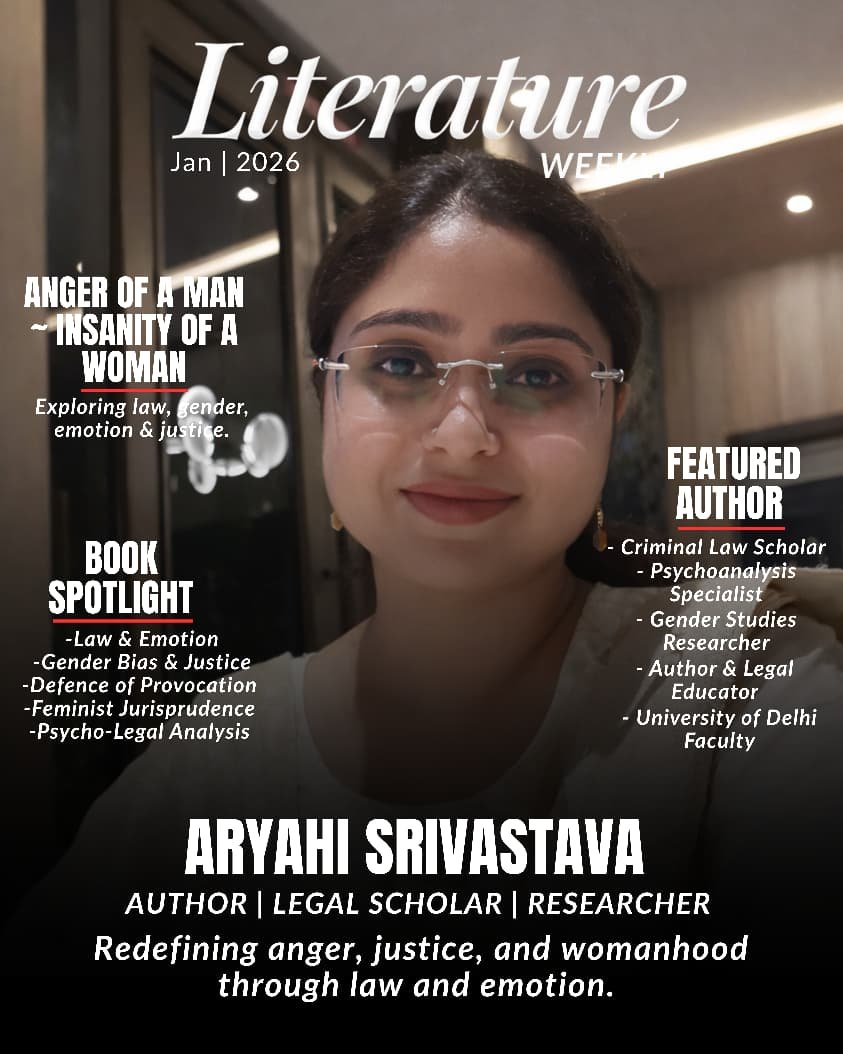
In Anger of a Man ~ Insanity of a Woman, Aryahi Srivastava undertakes a rigorous and unsettling inquiry into one of criminal law’s most guarded assumptions: that reason and neutrality govern judicial decision‑making. Drawing from criminal law, psychoanalysis, and gender studies, the book exposes how the legal system’s apparent rationality is quietly animated by emotion—selectively recognised, unevenly legitimised, and deeply gendered.
Srivastava, formerly a faculty member of Criminal Law at the Campus Law Centre, Faculty of Law, University of Delhi, brings to this work the authority of sustained academic engagement. Her scholarship—presented at institutions such as The Indian Law Institute, RGNUL Patiala, and IIT Kharagpur—has consistently examined violence, femininity, consent, and constitutional morality. This book extends that inquiry beyond academic discourse, offering a psycho‑legal critique that interrogates how law understands, excuses, and condemns anger.
At the centre of the book lies a close reading of judicial reasoning surrounding the Defence of Provocation, an exception to the offence of murder. Across five carefully structured chapters, Srivastava demonstrates how this doctrine, while framed as neutral, operates through a culturally coded lens. Male anger is frequently contextualised—understood as instinctive, situational, even inevitable. Female anger, by contrast, is medicalised, moralised, or rendered aberrant.
The book reveals how socio‑cultural expectations seep into legal reasoning under the guise of objectivity. Concepts such as honour, emotional restraint, and acceptable violence are shown to be unevenly distributed across gender. Women who express rage, or commit acts of violence, are rarely afforded the same narrative space as men. Instead, they are cast as irrational, excessive, or deviant—figures to be explained away rather than understood.
One of the book’s most forceful interventions lies in its claim that anger, for women, is treated not as a right but as a privilege—a conditional allowance, easily withdrawn. Srivastava argues that women across social locations are denied emotional legitimacy, their anger framed as a threat to social order rather than a response to it. The law, she suggests, becomes complicit in this erasure by cloaking bias in the language of fairness and reasonableness.
Importantly, Anger of a Man ~ Insanity of a Woman does not romanticise violence, nor does it seek to dismantle legal doctrine through ideology alone. Its critique is subtler and more disquieting. Srivastava exposes how the smoothness of legal rationality conceals instability at its core—how emotion, while officially disavowed, continues to govern judgment. The law’s refusal to acknowledge this dependence allows bias to persist unchecked.
The book also seeks reclamation. It calls for the recognition of women who are angry, violent, or transgressive—not as anomalies to be expelled from moral consideration, but as subjects shaped by social, emotional, and structural realities. In a world where angry men are accommodated and angry women are banished, Srivastava insists on restoring specificity to female victimhood and agency.
Now associated with Rahul’s IAS, Srivastava continues to engage with law as a living institution—one that reflects the society it governs as much as it shapes it. Anger of a Man ~ Insanity of a Woman stands as a necessary intervention in contemporary criminal jurisprudence, reminding readers that neutrality, when left unquestioned, can become the most persuasive form of injustice.
This is not merely a book about law. It is a demand that law finally reckon with the emotions it pretends not to hear.


A powerful and necessary intervention. What strikes most is how convincingly the book exposes “neutrality” as a carefully maintained illusion that quietly protects male anger while disciplining female rage.