


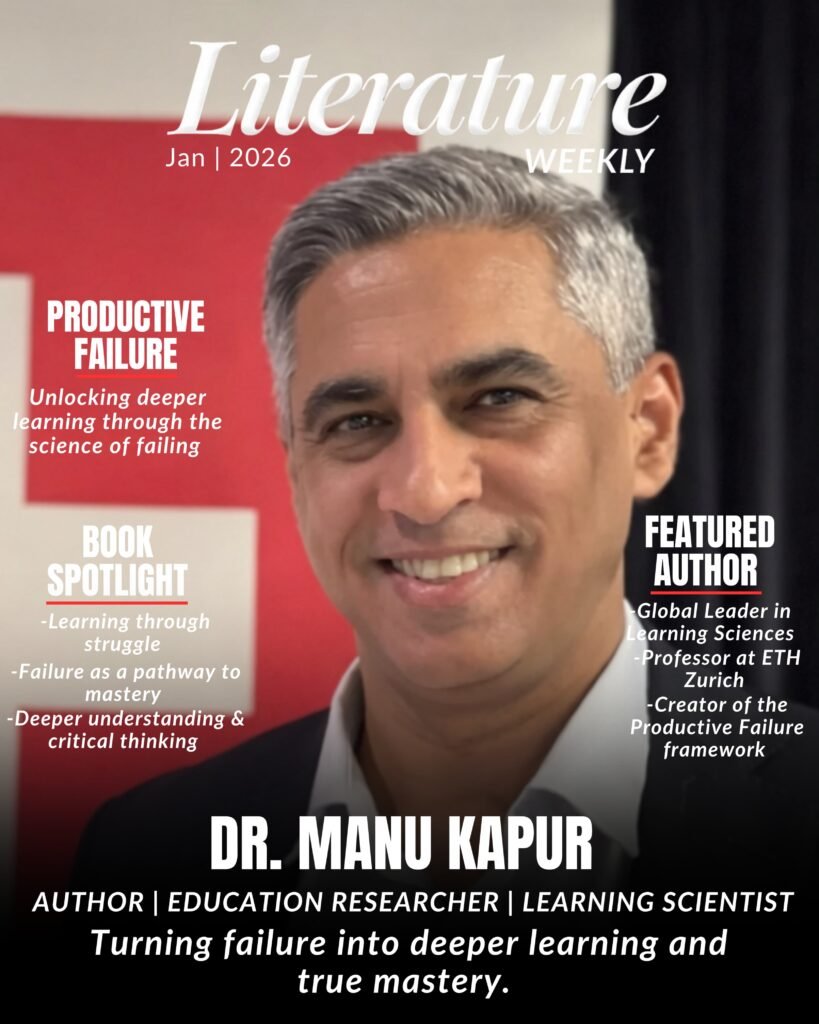
In an age increasingly preoccupied with efficiency, optimization, and measurable success, Manu Kapur has spent a distinguished academic career arguing for an idea that appears, at first glance, counterintuitive: that failure—when carefully designed—is not a detour from learning, but its most reliable path.
Currently the Director of the Singapore‑ETH Centre and Professor of Learning Sciences and Higher Education at ETH Zurich, Kapur stands at the confluence of research, policy, and practice. He also directs The Future Learning Initiative (FLI) and serves as the Founding Chair of the ETH Zurich–EPFL Joint Doctoral Program in the Learning Sciences, roles that reflect his sustained engagement with how learning systems are imagined, built, and reformed.
Yet it is through his book, Productive Failure, that Kapur’s most influential idea finds its clearest expression.
From Engineering to the Science of Learning
Kapur’s intellectual journey mirrors the philosophy he later articulated.
Trained initially as a mechanical engineer, and long devoted to mathematics, he taught college mathematics for several years and served as deputy leader of Singapore’s team to the 43rd International Mathematical Olympiad in Glasgow. It was in these classrooms—amid partial solutions, false starts, and moments of visible struggle—that a deeper question took shape: what happens in the mind when understanding has not yet arrived?
This curiosity led Kapur to doctoral studies at Columbia University, where he specialized in the science of learning and instructional technology. He holds a Master of Science in Applied Statistics from Columbia and a Master of Education from Singapore’s National Institute of Education—a combination that reflects both analytical rigor and pedagogical insight.
Out of this interdisciplinary grounding emerged a theory that would go on to reshape how failure itself is understood.
Reframing Failure
At the heart of Productive Failure lies a simple but unsettling proposition: learning does not require the avoidance of error; it requires meaningful engagement with it.
Kapur draws a careful distinction between failure that overwhelms and failure that invites inquiry. Total, unstructured failure can discourage and alienate. But well‑designed failure—bounded, purposeful, and intellectually safe—can cultivate resilience, creativity, and deep conceptual understanding.
In this view, failure is neither an endpoint nor a flaw in the system. It is a signal, drawing attention to the limits of current understanding and opening space for re‑organization of thought.
Designing for Learning, Not Just Instruction
The book sets out evidence‑based design principles for curating such productive failure. These principles guide educators, learners, and leaders in shaping experiences where struggle is expected rather than penalized, and where insight emerges gradually through engagement.
Importantly, Kapur does not confine these ideas to classrooms. He extends them to self‑directed learning, organizational innovation, and skill development, showing how individuals and teams can design tasks that stretch understanding without breaking confidence.
Readers are introduced to cognitively grounded strategies—such as retrieval practice, analogical reasoning, category formation, and counterfactual thinking—not as techniques to be mechanically applied, but as tools to deepen one’s relationship with learning itself.
From Theory to National Policy
What distinguishes Kapur’s work is not only its theoretical coherence, but its demonstrated impact at scale.
His research on Productive Failure has been adopted by Singapore’s Ministry of Education, informing the redesign of the nation’s pre‑university mathematics and statistics curriculum. Few educational theories travel so convincingly from controlled studies to national implementation.
Earlier in his career, Kapur also directed a $50 million interactive and digital media R&D programme at Singapore’s Ministry of Education, helping to lay the groundwork for interdisciplinary research in educational technology.
A Global Scholarly Presence
Kapur’s work has attracted sustained international attention, with coverage in outlets such as TIME Magazine, NZZ, The Straits Times, The Australian, and The Times of India. His research has secured approximately USD 13 million in funding, and he has held visiting professorships across Europe, Australia, and Japan.
A frequent keynote speaker at major academic and policy forums—including The Royal Society in the UK—he has also served as an associate editor for leading journals in learning and cognitive sciences, shaping the field from within.
Why Productive Failure Matters
At a moment when educational systems and workplaces alike seek certainty, Productive Failure offers a quieter, more demanding vision. It suggests that understanding does not arrive fully formed, but is assembled through effort, misjudgment, and revision.
The book does not celebrate failure for its own sake. Instead, it insists on designing conditions in which failure can do its work—illuminating assumptions, provoking questions, and ultimately leading to insight.
Closing Reflection
Productive Failure is neither a manifesto nor a manual. It is a carefully argued reflection on how learning actually unfolds—slowly, unevenly, and often through moments of not knowing.
In giving failure a rightful place in the ecology of learning, Manu Kapur reminds us that growth is rarely linear. It advances, more often, by thinking through difficulty rather than around it.
In that sense, the book does not merely describe a theory.
It models a way of understanding learning itself.