


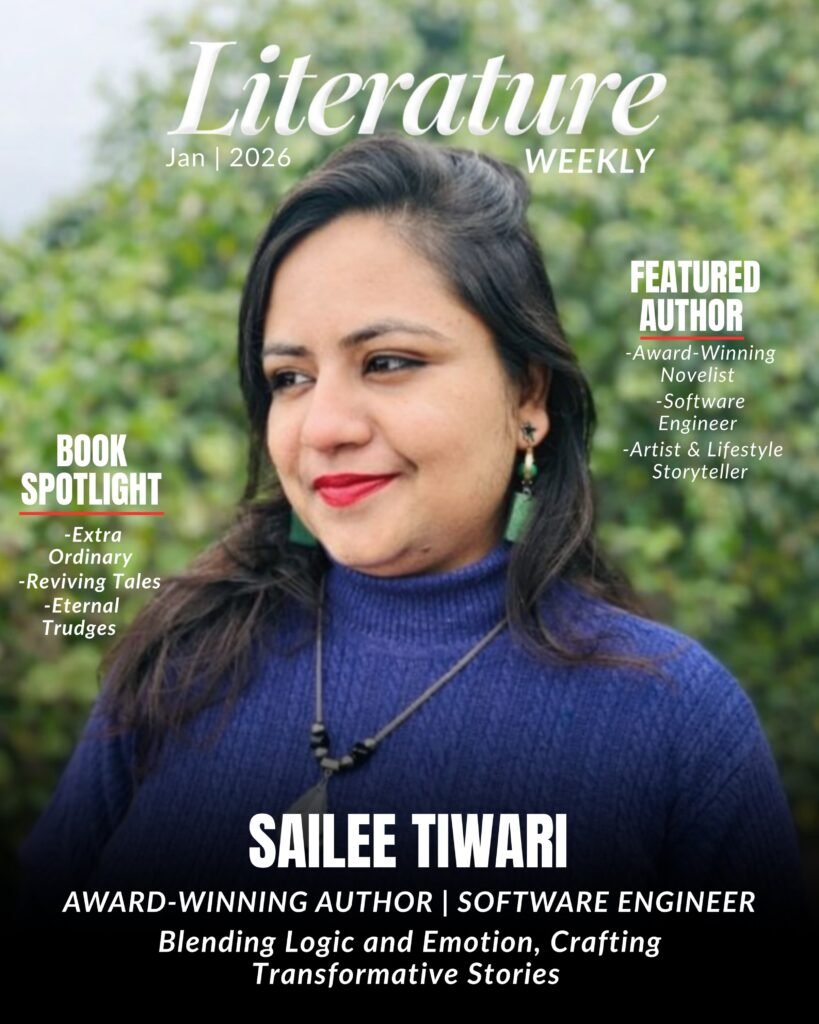
: When Logic Learns to Listen to the Heart
Some writers arrive at literature through instinct. Others arrive through discipline.
Sailee Tiwari arrives through both—and it is in this convergence that her work finds its quiet authority.
An award‑winning author of five novels and a technical lead in software engineering, Tiwari writes from a space where analytical clarity meets emotional attentiveness. Her fiction does not announce itself with spectacle; it draws the reader in through accumulation—of thought, feeling, and carefully observed human moments. The curiosity her writing generates lies not in what happens next, but in what it reveals slowly.
Her novels, including Extra Ordinary, Reviving Tales, and Eternal Trudges, return persistently to the inner life. Love, loss, resilience, and transformation are not treated as themes to be resolved, but as conditions to be lived through. Characters evolve quietly, shaped by reflection as much as by action. The prose is measured, resisting excess, yet it carries emotional weight through restraint rather than flourish.
This attentiveness extends to her widely appreciated collection Peace and Panacea, where healing is approached not as certainty but as process. Silence, vulnerability, and self‑recognition form the architecture of these pieces. Recognition has followed—through honours such as the India Prime Icon Award, the Kalam Ratna Award, and Writer’s Ink Awards—but her work remains notably inward‑facing, uninterested in noise.
What lends Tiwari’s writing its distinctive texture is her professional grounding outside literature. Her background in software engineering brings with it a respect for structure, pacing, and coherence. Yet the writing never feels mechanical. Instead, logic becomes a scaffolding on which emotion is carefully held. Each narrative appears deliberately built, but never over‑engineered.
Her literary presence has extended across platforms such as Outlook India, The Week, and DailyHunt, and through conversations on the podcast Reading The Author. These engagements situate her within contemporary literary discourse, but her work itself remains resistant to trend‑driven urgency. It asks for attention, not acceleration.
Beyond writing, Tiwari is also a visual artist. Through her art and lifestyle storytelling on Instagram, she explores the same concerns that animate her fiction—stillness, observation, and the relationship between inner and outer worlds. This visual practice does not compete with her writing; it complements it, suggesting a creative life shaped by coherence rather than compartmentalisation.
What ultimately distinguishes Sailee Tiwari is not productivity or accolades, but tone. Her work trusts the reader. It allows pauses. It understands that curiosity is sustained not by constant revelation, but by the promise that something meaningful is unfolding beneath the surface.
In a literary moment often defined by immediacy, Tiwari’s writing moves differently. It slows the reader down—and in doing so, makes space for reflection.